NASHVILLE, Tenn. – The NFL is packed with Mike Shanahan and Kyle Shanahan disciples, running variants of a wide-zone offense built on rhythm, motion and play-action.
Those systems still work, but they are also the most familiar looks defenses see.
Robert Saleh spent five seasons working for Kyle Shanahan, which made it logical to assume he’d lean in that direction offensively again.
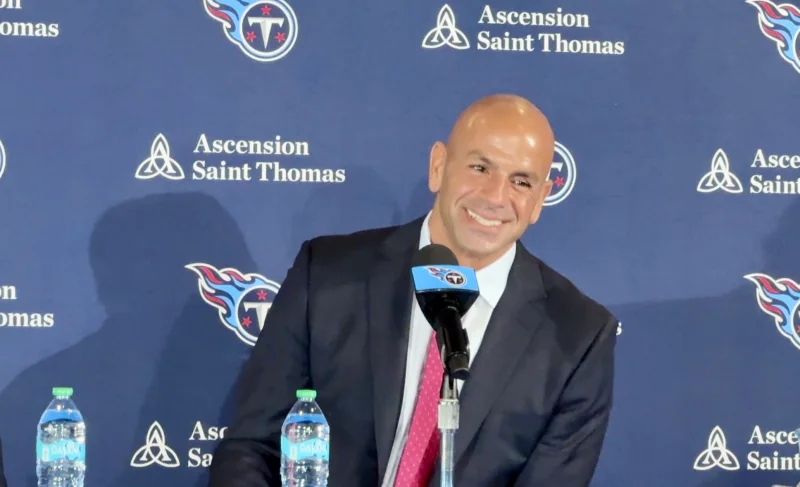
But now as coach of the Titans, he’s moving a different direction with Brian Daboll coordinating an Erhardt-Perkins system, built largely on shared concepts and option routes rather than fixed route trees. It requires communication, recognition and quarterback command with regular adjustments.
That’s not just about being different. It’s also about how Saleh wants to develop Cam Ward.
“So there is a level of game planning (against us) that is going to have to change within a week, so that’s first,” Saleh said. “Dabes has had a history of developing young quarterbacks in this league, in college. …
“As a defensive guy, game-planning against him, what he does, I can tell you that he’s always going to strain you, both run and pass. He’s going to find the run-pass conflicts within your scheme for individual players; he’s going to attack the shit out of it. He’s special in that regard.”
Cam Ward was at the press conference with a dozen other players and Mike Borgonzi said the quarterback is rehabbing and doing well. He suffered an injury to his throwing shoulder in the season finale on Jan. 4 in Jacksonville.
Cam Ward at Robert Saleh’s introductory press conference. #Titans. pic.twitter.com/2QuLtC0vgo
— Paul Kuharsky (@PaulKuharskyNFL) January 29, 2026
Saleh sees great possibilities in Ward. But he also recognizes a need to present him with reasonable guardrails to help him produce wins while young and learning.
He labeled him an “immense talent” who’s “fun to watch” and “cool to be around.”
But he looked to early Tom Brady and pointed to how he was under center, handing the ball off, playing with an elite defense and an unbelievable running back. The system allowed him to move the chains on third down, be great 2 minute, be efficient in the red zone and score.
“The best way to develop a quarterback is to give him a team that doesn’t make him feel like he needs to be Superman,” Saleh said. “At least early on. “There is going to be a time as Cam continues to develop where he can put this entire organization on his shoulders and lead it to a win.
“But asking that of a young kid, I think, is unrealistic. And so building a structure for him that doesn’t ask him to be Superman 60 plays a game will be at the front of our minds.”
 Saleh’s point was less about limiting Ward than about sequencing his development. The system he’s asking Daboll to install is designed to keep the quarterback connected to the structure of the offense, not responsible for rescuing it.
That will take a shift in Ward’s mindset. He’s been through a lot of offensive coordinators Saleh is asking Daboll, his sixth coordinator since he started college, to take him all the way back to the beginning.
“I don’t want to put a straitjacket on him either,” he said. “They all believe that they belong, all believe that they are Supermen. …So for Cam it’s just helping him understand what’s most important in that moment and helping him develop a mindset that he doesn’t have to be a hero. It’s OK to rely on your teammates.”
