By DREW BEATTY, film analyst
As April opens, the chaos of the NFL draft cycle is in full swing. The pre-draft process is hectic on any given year, but in a draft where the talent level is generally considered to be lower and the lines are more blurred, the parity dial is turned up tenfold.
While the Tennessee Titans spent most of the offseason being talked about as a prime destination for an edge rusher in the top five of the draft, the national media’s tune has changed drastically over recent weeks. Instead of the Rueben Bain or David Bailey mock drafts that most Titans fans had grown accustomed to, analysts such as ESPN’s Mel Kiper, The Athletic’s Dane Brugler, and NFL Network’s Daniel Jeremiah all unanimously mocked Notre Dame running back Jeremiyah Love to Tennessee.
This, of course, then sparked a heated debate over roster-building philosophy and positional value. While the questions of positional value and whether or not the Titans’ roster is in a place to select a running back in the top-five are both worthwhile and relevant, the discussion has shifted after PK revealed that if Tennessee’s top brass believes Love to be a blue-chip prospect, they’ll take him. So, rather than breaking down the intricacies of roster construction and positional value, the discussion shifts to whether or not Love is a blue-chip prospect.
Love’s athletic profile
Beginning with Love’s premier attribute, his athleticism is what truly separates him from most running back prospects. Athleticism can often be a broad, umbrella term in draft evaluation. In Love’s case, it encapsulates his elite first-level burst, short-area quickness and home-run long speed.
The first and most obvious trait that separates Love from your typical running back prospect is his sudden explosiveness. The amount of ground that he can cover with one step because of the springiness in his feet is baffling. Whether it be his vertical explosiveness through a hole at the line of scrimmage or his jarring lateral quickness, Love seemingly glides around the field like a figure skater.
Love also pairs his lethal agility with blistering long speed. In a running back class full of players who can consistently hit singles or doubles but lack the long speed to turn them into home runs, Love distances himself as a constant explosive-play threat. If he’s given a window into the open field, it’s extremely rare to see him get hawked down from behind.
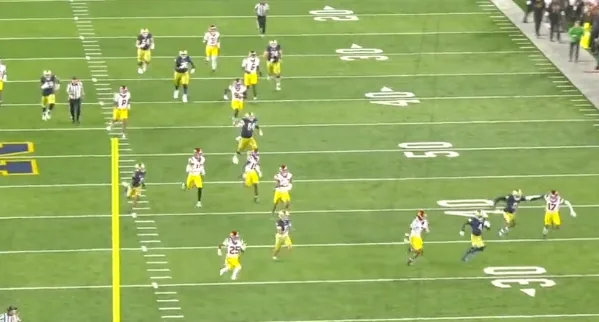
This run from Notre Dame’s matchup against Boston College is a perfect example of how all of Love’s aforementioned movement skills come together to make him a home-run hitter. The Irish are running duo from their own goal line and just after taking the handoff, Love hits a quick sidestep that causes both the linebacker (No. 1) and the safety (No. 0) to take just one false step too far to the strong side.
This sidestep also allows time for Love’s blocks to set up in front of him, and as he approaches the line of scrimmage, Love displays his change-of-direction ability and explodes back through the cutback lane that his sidestep helped create. Once he hits the cutback lane, Love is off to the races and showcases his blazing long speed en route to a 94-yard touchdown run.
Love’s skillset as a runner
In addition to his athletic traits, Love also possesses a nuanced skillset as a runner. Bringing a blend of vision, patience, contact balance and open field creativity, he brings near the total package as a prospect.
Love’s vision
There are two specific areas that I believe make Love a quality first-round prospect, but keep him just shy of the blue-chip label. When evaluating running back prospects, vision is one of the most crucial traits to translate to the next level. The truly best-of-the-best running back prospects have a level of vision that borders on prophetic foresight. They’re able to see lanes before they even open and manipulate second-level defenders with only their eyes.
While Love does have firmly above-average vision, I wouldn’t necessarily place him in clairvoyant caliber. He often does use both his eyes and impressive footwork to manipulate second-level defenders and hunt down potential cutback lanes, but he falls just shy of the elite tier of vision.
Love’s contact balance
The second of the areas in which Love is only good rather than great is his contact balance. Again, the Saquon Barkley, Bijan Robinson, etc. echelon of running back prospects is a constant, churning nightmare for defenders to get on the ground. The level of lower-half power that they run with is a significant portion of what makes them truly elite runners.
My intention is not to paint Love as a weak, down-on-first-contact runner — he isn’t. Love still consistently displays the ability to run through arm tackles. He just lacks the top-tier level of raw power and contact balance that I believe a blue-chip running back prospect needs to have.
Love’s open field creativity and elusiveness
While contact balance and vision are two traits that I believe limit Love to an extent, his open field creativity and elusiveness are some of the best that I’ve ever evaluated. Many backs struggle with a lack of creativity at the second and third levels when tasked with beating defenders in open space. They often opt to just run straight into and/or over these defenders in space. However, Love has absolutely no shortage of creative ways to win in the open field.
Aided by his aforementioned burst and fluidity, Love is one of the most elusive, slippery players I’ve ever watched. He can evade defenders in space with a plethora of moves, but his clear favorite is his spin move.
In this rep from Notre Dame’s game against Pittsburgh, Love takes the handoff on a power run concept. He showcases impressive patience waiting for his blocks to set up and eventually hits the hole to find himself one-on-one with Pitt’s single-high safety. Love breaks down and hits him with the trademark spin move – sending him to the turf and breaking Love loose for a 55-yard touchdown run.
Another rep in which Love blends all of the previously mentioned aspects of his running arsenal together is this run against Purdue. Running a duo concept, the play is designed to attack the interior. However, Purdue’s strong side defensive end crashes down and collapses the entire interior, also freeing up a cutback lane.
Surveying all of this as he takes the handoff, Love hits his bend read and cuts his run outside. Showcasing extremely impressive peripheral vision and elusiveness, Love hits an additional two more cuts towards the sideline to elude two secondary defenders in space. As he reaches the boundary, Love corners like a NASCAR and hits the afterburners down the numbers en route to yet another 50+ yard touchdown run.
Love’s third-down skillset
Yet another piece of Love’s arsenal that separates him from the pack and contributes to the best-in-the-class label that so many seem eager to throw onto him is his impact on the passing attack. In addition to being a force in the ground game, Love also injects a dangerous receiving profile into an offense. Love’s high-octane athleticism makes him a lethal separator out of the backfield.
In this clip from Notre Dame’s game against Arkansas, the Irish have Love lined up at slot receiver out of an empty formation. Love flashes surprising tempo as a route runner at the start of his route from the slot, beginning his stem slower before exploding vertically into his break. His burst (combined with a small push-off) leaves Arkansas linebacker Bradley Shaw with a face full of grass. Love also shows noteworthy body control to haul in CJ Carr’s pass in-bounds.
While his receiving profile is nothing but infatuating, Love’s presence in pass protection is a somewhat less attractive profile. He has proved to be most serviceable when helping protect the quarterback. However, it seems that almost annually now we see first and second-year running backs who struggled mightily in pass pro during their collegiate careers develop into solid pass protectors (such as New York’s Cam Skattebo in 2025). That skill has proved to be one of the most coachable skills for NFL running backs, and it would be foolish to knock Love too drastically for such a teachable aspect of the position.
 In summary, Love is an exceptionally enticing running back prospect who carries a mid first-round grade on my personal draft board. I believe he will be a quality starter at the NFL level. However, I do not believe that he is a blue-chip prospect. I still firmly stand behind edge rusher being in Tennessee’s best interest with the fourth-overall pick.
Ultimately, my thoughts on Jeremiyah Love are inconsequential. It matters whether or not Mike Borgonzi and the rest of the Titans’ front office believe Love to be a blue-chip prospect. As we near April, the season of smoke and mirrors is in full effect, and we are sure to see more information, both true and false, about Tennessee’s plans in the first round.
Regardless of what the Titans opt to address with their first pick, Love is undoubtedly sure to make the cut of options on the table. With the Arizona Cardinals retaining running back James Conner, signing former Falcons’ back Tyler Allegier and currently developing 2024 top-70 pick Trey Benson, it would seem that Love will be available for Tennessee’s first selection. The only question left to answer remains whether or not they deem him worthy of the fourth-overall pick.

Support independent Titans coverage
PaulKuharsky.com is independent Titans coverage supported by readers. Paul has covered this team since 1996 — longer than any active beat reporter.
Full access to every member story, film study, and podcast is $7.50/month or $81/year.