By DREW BEATTY, film analyst
As the eve of another year’s NFL Draft dawns, the rumor mill surrounding the Tennessee Titans’ draft plans is still rapidly swirling. Will Tennessee pull the trigger on a running back in the top five? Will Robert Saleh get his new cornerstone linebacker in Sonny Styles? Will one of the top edge rushers fall to the fourth pick? Will they trade back from their current pick? These are all the same questions that have been asked throughout the whole draft cycle, and seem to be staying relevant up until 8 p.m. ET on draft day.
While the 2026 draft is projected to be one of the more unpredictable classes in recent memory, analyzing player fits and the front office’s pre-draft touch points leaves enough breadcrumbs to try and paint a somewhat realistic picture of Tennessee’s plan. My previous two mock drafts have included a hefty dose of my own personal rankings, but this final pre-draft mock will be purely predictive.
Round One, Pick Four - Jeremiah Love, RB, Notre Dame
Much like it has since the combine in March, the scenario of both Ohio State’s Arvell Reese and Texas Tech’s David Bailey both going in the top-three seems increasingly likely. Operating under that assumption, the Titans add one of the premier offensive weapons in this draft in Jeremiyah Love to support Cam Ward.
I still remain steadfast in the thought that Borgonzi is far too process-oriented to be ecstatic with taking a non-premium position like running back in the top-five, but ultimately, taking Love may be somewhat of a necessary evil in this draft class. With the premier edge rushers already off the board, Tennessee opts for talent over positional value. While Ohio State linebacker Sonny Styles and a potential trade back are both still firmly on the table, I believe a Love connection to be the most likely possibility at the fourth-overall pick.
Love brings an electrically-charged athletic presence to the backfield as a constant home run threat. His elite blend of short-area quickness, blistering long speed and open field creativity makes him one of the most enticing running back prospects of the last decade. In addition to his skillset as a runner, Love also brings a fleshed out receiving profile to give Cam Ward a threat out of the backfield. In an ideal world, the fourth-overall pick could be utilized to fill a roster hole at a premium position, but in this draft class, adding a high-caliber running back prospect to relieve pressure from a second-year quarterback is a worthwhile addition.
Round Two, Pick 35 - Chase Bisontis, G, Texas A&M
As Tennessee enters the draft, the roster currently has gaping holes at both center and right guard. Throughout the pre-draft process, Mike Borgonzi has alluded to his experience in Kansas City starting rookie offensive linemen, and has publicly stated that he isn’t too shy to do that in Tennessee. While I believe the front office would love to trade back from their pick at the top of the second round and add more draft capital, there are some players that if available, trump the option of trading out. With the current roster construction, I believe Texas A&M’s Chase Bisontis to be one of those players.
Bisontis, at 6-foot-5 and 315 pounds, is a brick on the interior. He provides one of the soundest pass protection profiles of any offensive lineman in this draft. His combination of technically advanced hands, a strong anchor and impressive footwork make him an NFL-ready, Day One starter.
While not an elite athlete, Bisontis is a solid enough linear athlete in space to pull off the movement that would be asked of him in Daboll’s run scheme. Run blocking isn’t a premier attribute of Bistonis’ profile, but he’s more than serviceable for how polished he is as a pass blocker. He would project as an immediate starter at guard, opposite of Peter Skoronski, and help to keep Ward’s jersey a little bit cleaner.
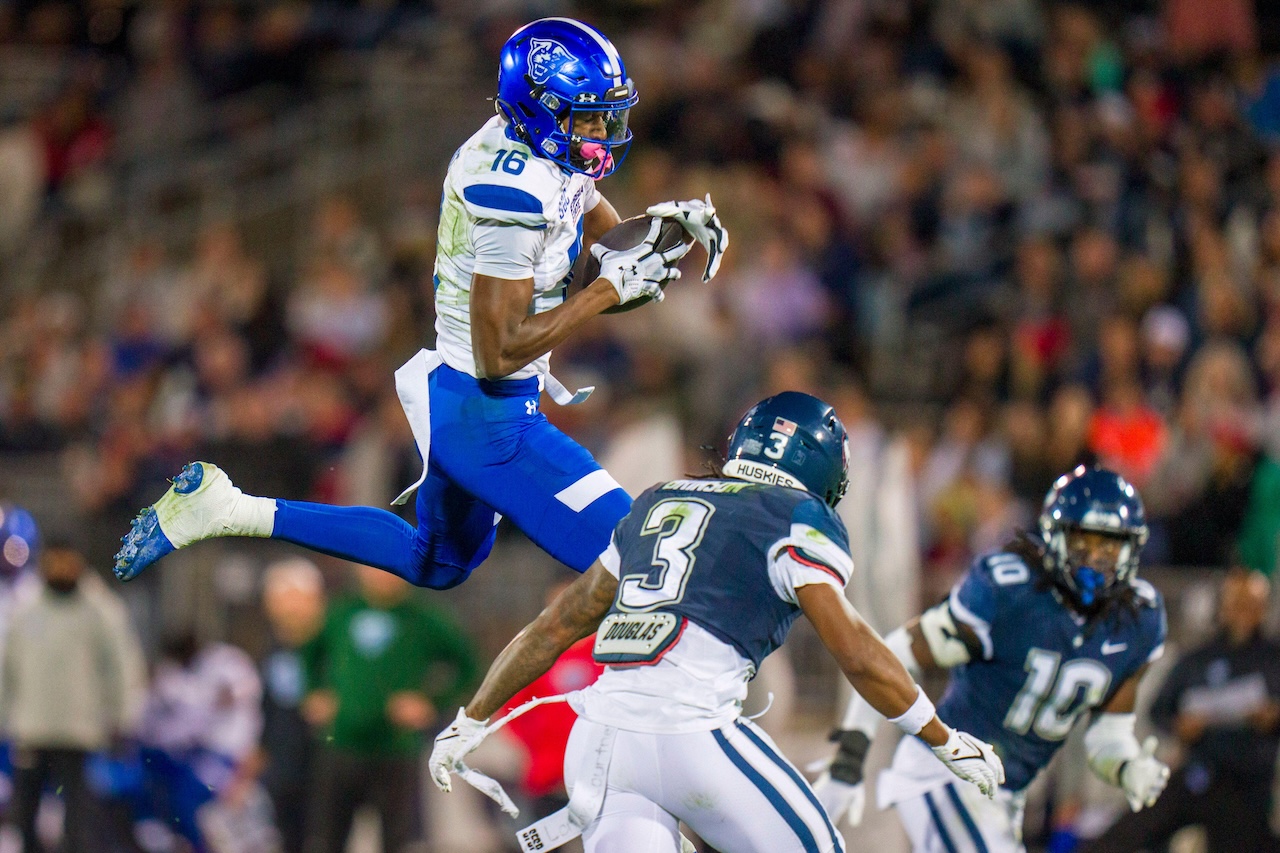
Round Three, Pick 66 - Ted Hurst, WR, Georgia State
Continuing the theme of additions to help improve the offensive supporting cast, Tennessee adds Georgia State wide receiver Ted Hurst with the 66th overall pick. In an April 10th draft intel piece from ESPN, analyst Jordan Reid said:
“Even after signing Wan'Dale Robinson in free agency, the Titans likely aren't done adding pass catchers, but more additions probably won't come until Round 3 or 4. Ted Hurst (Georgia State) has been frequently mentioned when discussing the Titans' receiver options with sources.”
I also mentioned Hurst as a Day-Two fit in my April 8th article about potential X receiver options in the draft. At 6-foot-4 and 206 pounds, he projects as the exact prototypical, boundary receiver that the Titans’ offense is missing.
Even with his daunting size profile, Hurst is a high-octane athlete who poses a constant vertical threat to defenses. His long strides allow him to eat up turf quickly and stack defensive backs, while his elite hip-sink and deceleration ability make him a high-end intermediate separator.
Most of all, Hurst also excels as a contested catch artist. Using his huge frame to outmuscle defenders and utilizing his late hands, he has mastered the nuance of jump balls. Injecting Hurst into the existing receiving corps of Chimere Dike, Robinson and Calvin Ridley would add a high-ceiling, X receiver to Ward’s arsenal.
Round Four, Pick 101 - Jalon Kilgore, DB, South Carolina
Holding the first pick of Day Three for the second consecutive year, the Titans hope to recreate the success of last year’s 101st overall pick by taking South Carolina defensive back Jalon Kilgore. I wrote last week about how Robert Saleh’s incoming defensive schematic changes in turn make the roster hole at nickel more pressing. Marcus Harris showed flashes during his rookie season, but Tennessee needs a bigger, more versatile “chess piece” in the slot. The 6-foot-1, 210-pound defensive back would be the big nickel presence Saleh’s defense is currently lacking.
Kilgore projects as an immediate plus as an apex run defender. He has the combination of size, length and linear athleticism to be a reliable zone defender. That length also translates to his consistent disruption at the catch point. The addition of Kilgore would not only add the physical nickel presence that the defense needs, it would also allow Harris to develop and diversify his role as a depth defender.
Round Five, pick 142 - Anthony Lucas, EDGE, USC
This selection is probably the one that I’m least confident in being a realistic possibility, but if he were to make it to the fifth round, USC edge rusher Anthony Lucas would be a dream fit for Saleh. It’s no secret at this point that Saleh consistently prioritizes length and athleticism in edge rushers. As far as mid-Day Three dart throws go, Lucas has plenty in both departments.
Standing at 6-foot-5 with 33½” arms and impressive twitch, Lucas has the traits to make an ideal, high-upside swing in the fifth round. While Lucas may not have the lower-body flexibility to consistently threaten the corner, he does threaten the B-gap with his striking lateral agility. He still needs to show a more repeatable and translatable way to win as a pass rusher at the next level. But the flashes of a dangerous cross-chop, a swipe move and a potent bull rush when he wins the leverage battle are plenty to be hopeful about.
In addition to his pass-rushing skill set, Lucas also flashes surprising efficiency as a run defender for somewhat of an undersized edge rusher. Even at 256 pounds, he displays controlling upper-body strength and uses his length to stack-and-shed opposing tackles. He will need to develop a more reliable way to win and hone in a more concise pass rushing plan at the next level, but Lucas has an abundance of traits to bet on with a mid-round upside swing.
Round Five, pick 144 - Justin Jefferson, LB, Alabama
In an ideal world, the Titans would certainly prefer to add an upgrade at linebacker sooner than the middle of Day Three, there are only so many resources to allocate. However, if they’re going to rely on a fifth-round pick to upgrade the linebacker room, Alabama’s Justin Jefferson has the traits to bet on. Tennessee also had Jefferson in for a 30 visit in early April.
#Titans had Alabama LB Justin Jefferson in for a 30 visit today per source.
— TURRON DAVENPORT (@TDavenport_NFL) April 7, 2026
Jefferson does have some worrying frame limitations at only 225 pounds, but what he lacks in size, he more than makes up for with athleticism. Saleh has an extensive history of wringing high-end production out of later-round picks at linebacker, and Jefferson has the sideline-to-sideline range necessary to find success in Saleh’s defense.
Even as a smaller linebacker, Jefferson is a bottle rocket against the run. He moves extremely well laterally, navigates the flow of traffic and run fits downhill like a blur. Jefferson is also much more of a block evader at the second level than he is a shedder. While his lack of size and play strength can lead to him getting shut down whenever bigger blockers get their hands on him, he brings a surprising amount of stopping power as a tackler.
One of Jefferson’s larger shortcomings outside of limited size is his coverage profile, which is vital for a linebacker in Robert Saleh’s defense. His spatial awareness and coverage IQ is a work in progress, but he has more than enough athletic traits to eventually grow into a reliable coverage linebacker. He probably would not beat out other options on the roster to be a starter early on in his career, but adding an athletic, developmental linebacker like Jefferson into Saleh’s defense is an investment for the future.
Round Six, Pick 184 - Will Kacmarek, TE, Ohio State
Transitioning to the first of the Titans’ three later Day-Three picks, Tennessee adds another young presence into the tight end room with Ohio State’s Will Kacmarek. While Gunnar Helm and Daniel Bellinger are certainly capable inline blockers, the Titans’ offense still lacks a dominant blocking presence in the room. The 6-foot-5, 260-pound Buckeye product was a consistent mauler inline for Ohio State’s offense.
Kacmarek showcased elite drive, power and technique as a run blocker while also displaying surprising burst for a bigger tight end. His impressive fluidity for his size and deceptive athleticism make him a serviceable receiving option while being a high-end blocking presence. Kacmarek’s addition to Tennessee’s tight end room would both give them a designated blocking force and improve the offense’s versatility in 13 personnel.
Round Six, Pick 194 - Latrell McCutchin Sr., CB, Houston
Heading into the offseason, cornerback was a gaping hole in the roster. However, after spending the gross domestic product of a small Mediterranean country on cornerback additions in free agency, that position group slid further down the list of needs
Thus leading into the first boundary corner addition of this draft being on late Day Three in Houston’s Latrell McCutchin Sr., Tennessee has already acquired their two starting boundary corners in Alontae Taylor and Cor’Dale Flott as well as one depth piece in Joshua Williams, but they still could use more depth on the outside.
McCutchin also happens to be one of the players that the Titans have shown the most pre-draft interest in. During an interview with Sports Illustrated’s Justin Melo, McCutchin said, “I’ve met with the Tennessee Titans multiple times throughout this process, virtually and at the combine.”
.@UHCougarFB's Latrell McCutchin Sr. is a fun CB in this NFL Draft. Buncha tackles (51) and PBUs (9) this past season.
— Justin M (@JustinM_NFL) April 17, 2026
6-2, 192-lb CB who ran 4.43 and jumped a 91st-percentile broad (10'11").
👉 @Bil_Trell joins NFL Draft On SI https://t.co/IkiZ5tw2yf
Moving beyond the obvious pre-draft intrigue, McCutchin also fits Borgonzi’s seemingly uniform preference in corners. Borgonzi has shown a consistent affinity for long, physical outside corners. That description fits McCutchin’s profile to a tee.
At 6-foot-2 and 190 pounds with 31 ¼” arms, what McCutchin lacks in athleticism, he makes up for in size and physicality. He’s not a track star outside cornerback, but he uses his powerful frame to knock receivers off course at the line of scrimmage and to consistently create disruption at the catch point. The Titans are still in need of young, quality depth pieces in the secondary, and McCutchin brings yet another big-bodied presence to the room.
Round Seven, Pick 225 - Jordan van den Berg, DT, Georgia Tech
In addition to spending at cornerback, the Titans were also big spenders at defensive tackle — adding star defensive lineman John Franklin-Myers. However, Tennessee also lost a multitude of quality pieces, trading T’Vondre Sweat and losing Sebastian Joseph-Day and James Lynch in free agency.
Tennessee did replenish some of their lost depth by signing Jordan Elliot and trading for Solomon Thomas, but they still have room for more rotational bodies in the defensive line room — especially ones with pass rushing upside. Saleh’s defense once again prioritizes athletic ceiling by taking Georgia Tech defensive lineman Jordan van den Berg with their last pick in the draft.
After not being invited to the combine, van den Berg boasted one of the most impressive pro day performances of the entire draft cycle. Measuring in at 6-foot-3 and 310 pounds, he put up a baffling 4.94 40-yard dash, a 36” vertical jump, a 9-foot-11 broad jump and a 4.19 second shuttle time. Elite in almost every athletic testing category, his numbers show up in his get-off on tape.
Van den Berg’s short-area quickness at 310 pounds is equal parts jarring and lethal to guards who are unable to mirror his speed on the interior. He also flashes a violent and effective club-swim move.
Van den Berg also projects as more of a penetrative run defender than a react-and-shed defensive tackle. His anchor isn’t quite what one would hope for in a 310-pound frame and he plays consistently off-balance and top-heavy, but his quickness off the snap allows him to be a gap-shooting run defender rather than a traditional nose tackle. Van den Berg would add a high-upside, athletic presence into Saleh’s defensive line rotation with the potential to develop into a quality, rotational interior pass rusher.
***
Tennessee’s roster has more holes than can be addressed in one draft, but the goal of surrounding the second-year franchise hopeful quarterback with offensive help was achieved. With the Titans' top-100 picks, they added one of the best running back prospects of the last decade, a new immediate starter at right guard and a high-upside X receiver. Plenty of the defensive holes still need to be addressed, but the offensive additions are reason enough to be excited for 2026.

Support independent Titans coverage
PaulKuharsky.com is independent Titans coverage supported by readers. Paul has covered this team since 1996 — longer than any active beat reporter.
Full access to every member story, film study, and podcast is $7.50/month or $81/year.