Tennessee's rebuilt receiver room believes it can win one-on-one, and the Jets may provide an immediate test of the one question the preseason couldn't answer.
By PAUL KUHARSKY
NASHVILLE, Tenn. – Confidence in the Titans' wide receiver room is as high as it's been in some time, and with good reason.
It's a diverse, skilled group with depth.
But none of that will matter Sunday if the Jets line up in man coverage on crucial downs and Tennessee's receivers can't shake them.
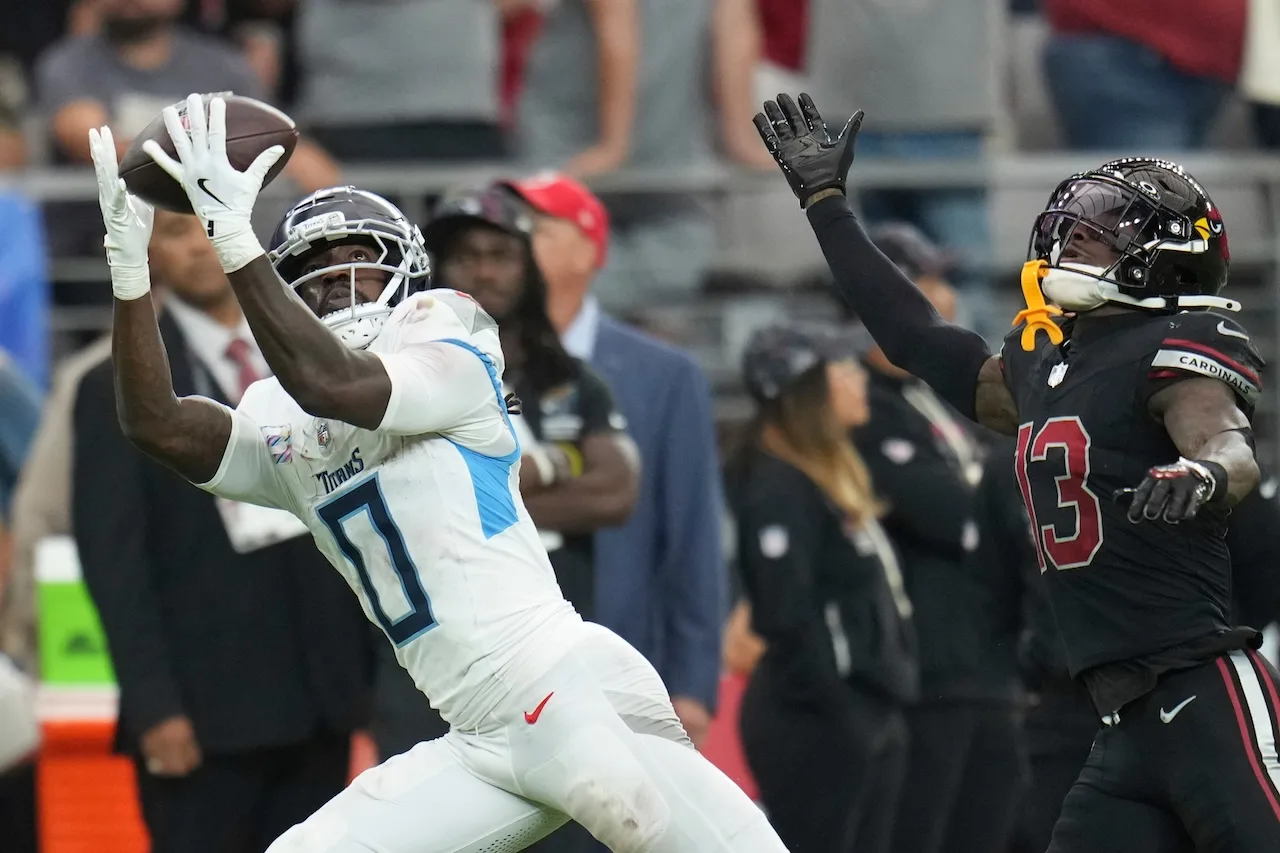
That's the big question left unanswered by a vanilla preseason: Can Carnell Tate, Calvin Ridley, Wan'Dale Robinson, Elic Ayomanor and Chimere Dike get off press coverage at the line and separate from defenders?
NFL defenses played man coverage on just 22.6 percent of snaps in 2025, according to PFF, the league's lowest rate in years. But the Titans will face some of the teams that played the highest percentage in 2025 – the Eagles, the Browns and the Lions. Sharp Football had the Jets at 31 percent.
There are reasons to expect that number to rise a year after the team didn’t come up with a single interception and added long, physical corners in Brandon Stephens from the Ravens and Nashon Wright from the Bears, who can press as well as better safety help in Minkah Fitzpatrick (Miami) and Andre Cisco (Jacksonville), who can help the defense trust its corners more.
Aaron Glenn has praised 2025 third-round corner Azareye'h Thomas’ work as a route disruptor.
The Coverage the Titans Want
The Titans want it, not zone.
“Live for it,” Cam Ward said. “Makes my job easier. It makes (receivers’) job easier. All they got to do is beat the person in front of them, and you know you can't hide from it. It's going to be somebody in your face, and maybe they may play off of you, man coverage. At the end of the day, you know they have to get open. I also got to throw them accurate footballs to them. You know when they're not as open, throw them open.”
Calvin Ridley, who’s made his career on route craft, said he expects the Jets to man up.
“I do think they will play man,” he said. “I've played against Glenn's defense, a couple of teams he had. I do think they're going to play man. I do think we're ready for it and we have to be ready for it and we will be ready for it.”
The Titans get better with Wan'Dale Robinson added to the group. And Tate arrived with evidence that separation should be a strength. As part of its draft evaluation, Pro Football Focus said Tate ranked in the 90th percentile in separation metrics both overall and against single coverage.
Yet Tate went without a catch in the preseason and didn't consistently look open, though he had an excellent day in the final joint practice against the Bears. The college numbers say he can separate. NFL corners will make him prove it.
What the Numbers Say About Separation
Two different metrics measure how receivers do at gaining space from their defender.
ESPN’s Open Score “assesses the likelihood a receiver would be able to complete a catch, conditional on if he were targeted. The assessment takes place a moment before pass release (0.2 seconds prior), because defenders read the shoulders of the quarterback at release and break on the targeted receiver.” It’s on a scale of 0-99 where 50 is roughly league average.
And the NFL’s Next Gen Stats offers a separation number that gives the distance in yards from the nearest defender as the time of the catch or incompletion.
Here is the available NFL baseline for four Titans receivers:
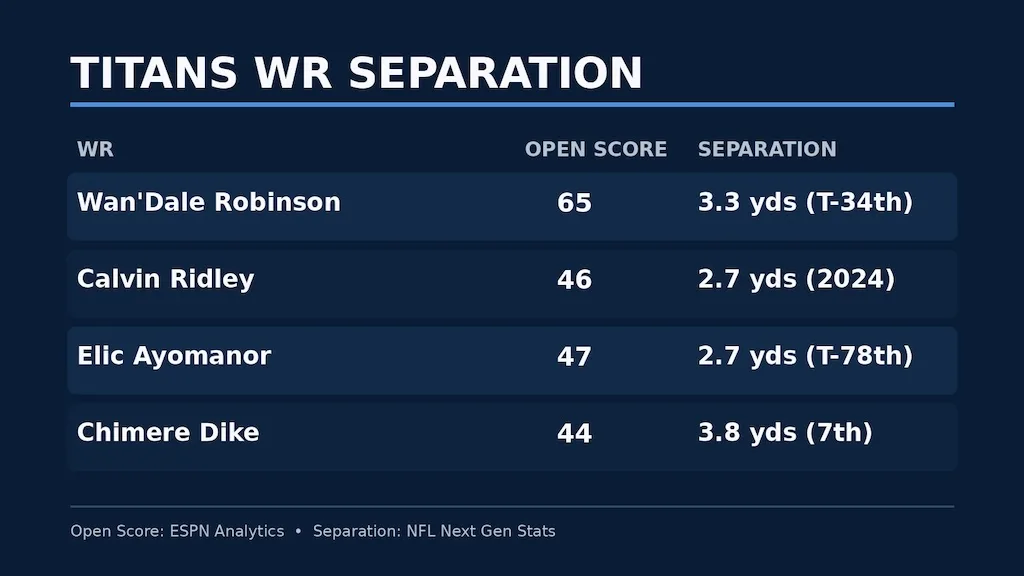
Ridley is likely to be the receiver who pulls away from defenders the least, requiring the best timing and synchronization with Ward.
Dike’s a standout there for what he did as a separator as a rookie.
He said he feels good about where he is heading into Week One.
“I’ve made a lot of progress,” he said. “At the end of the day, football is about winning your one-on-one matchups. As a receiver, that is our ultimate job: to go out there and beat man coverage. Every receiver is eager to see man coverage. When the defense plays man, you get the ball more.”
Operating out of the slot, Robinson will certainly have moments when sitting down in holes in zone can get the Titans key conversions.
But his biggest run-after-catch chances are likely to arrive against man.
“You have some plays that are designed for zone and some that are designed for man,” he said. “But it’s in all of us. I  don’t think any of us would be here without that aspect of playing receiver; that’s what we’re all going out there looking for (one-on-ones versus man). I’d say we’ve made tremendous gains as a group at it.”
Those gains include multiple elements, and Robert Saleh said he’s confident his receivers have put in their work at all of them.
“Obviously, there's a lot of film study with regard to the best way to attack from a release standpoint, whether you're speed releasing, whether you got to work at the line of scrimmage to create separation,” he said. “There are different tools that you're going to use just to get off the line first and foremost and then when you do get off the line, how you set up at the top of your routes and how you get out of your breaks.”
The Titans believe they have more receiving talent. Sunday starts showing whether they also have receivers who can consistently create the space Ward needs.

Support independent Titans coverage
PaulKuharsky.com is independent Titans coverage supported by readers. Paul has covered this team since 1996 — longer than any active beat reporter.
Full access to every member story, film study, and podcast is $7.50/month or $81/year.